How to Use Advanced Search
ContactsFlow™ (formerly Shared Contacts for Gmail™) levels up your contact sharing through the advanced search feature. It allows you to do an advanced search in Google Contacts and other integrated contact databases. Unlike the ordinary contact search bar, the advanced search allows users to specify which field the query should search from.
The advanced contact search is organized into key sections:
Field, Operator, Value, and the optional additional criteria.
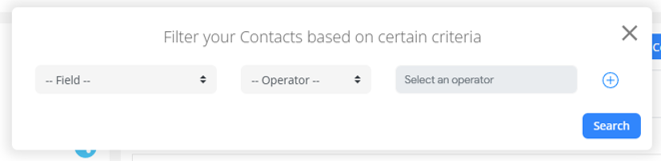
- Field
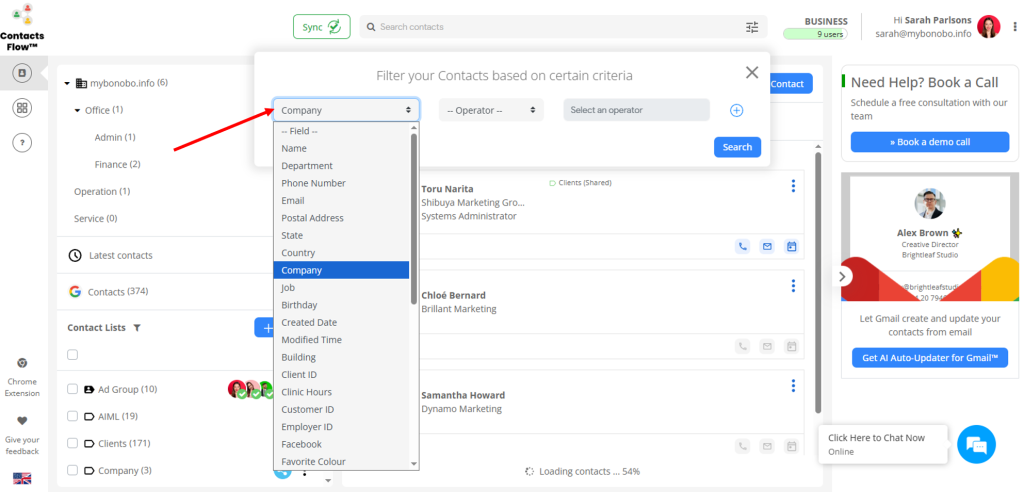
Select the field where you want to search in particular. Aside from the standard Google Contacts fields like name, company, or country, you can also find in the dropdown menu all the custom fields you have created.
- Operator
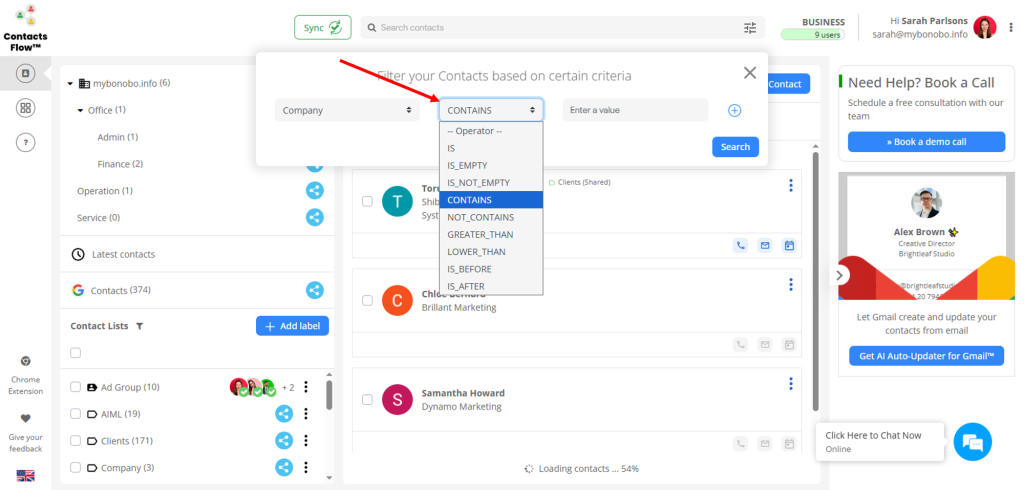
The operator defines what to do from the given field. It consists of pre-defined conditions:
- Is
- Is empty
- Is not empty
- Contains
- Not contains
- Greater than
- Lower than
- Is before
- Is after
- Value
The value is the data used as the parameter for your search. In the default Google Contacts search, this is the only field where you enter text to begin searching. With the advanced search feature, however, the value works together with the selected field and operator to apply specific conditions to the search.
- Additional Criteria
You can add another condition to further refine your search. Both condition works together to narrow down the results based on the criteria you define. This allows you to build more precise queries and quickly find the exact contacts you’re looking for.
Using the right combination of criteria improves how you manage your contacts. Learn them in the next section.
Practical Ways to Use the Advanced Search Feature
A. Find contacts from a specific field
B. See a list of contacts excluding a particular keyword
C. Search contacts with no email, phone number, or other fields
D. Filter contacts by date (Before or After)
E. Filter Contacts from a value less than or greater than a certain number
The advanced search feature lets you define specific conditions to filter your contacts and display the results that match them. This helps you quickly identify the exact contacts you need. By adjusting the conditions, you can make your search broader or more precise depending on your needs.
Let’s take a closer look at these practical use cases.
A. Find contacts from a specific field only
Suppose you’re trying to find all contacts from Taylor Industries, but the company may be saved under slightly different names such as “Taylor Industries,” “Taylor Ind,” or even “Taylor Corp.” At the same time, your contact list may include many individuals with the first or last name “Taylor.” If you simply search for “Taylor” in Google Contacts, the results will include both companies with “Taylor” in their name and all individuals named Taylor, making it difficult to find the exact contacts you need.
To narrow your search and get more relevant results, use the advanced search feature as follows:
1. Go to your ContactsFlow™ (formerly Shared Contacts for Gmail™) dashboard.
2. Click the advanced search icon (
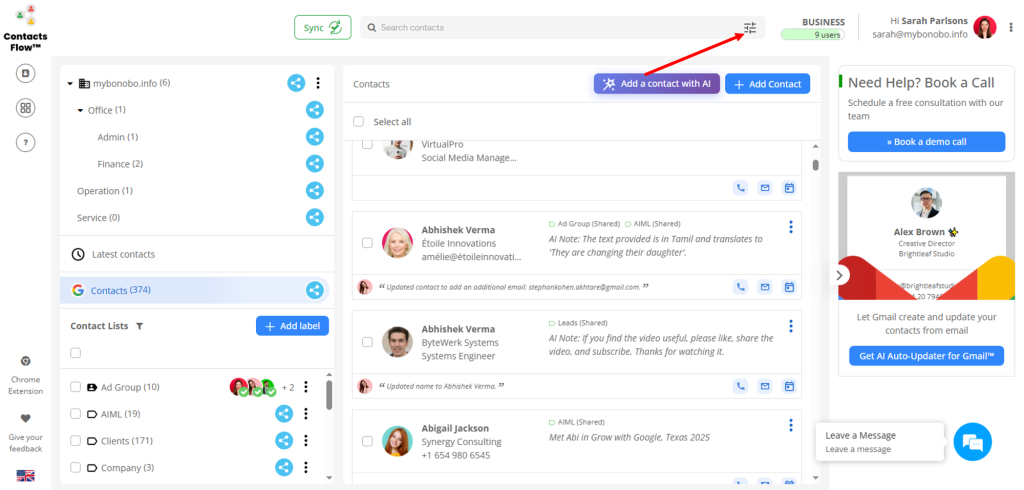
3. Select from which field you want the query to be searched from.
4. Select the operator.
Use “is” when you need an exact match. For example, entering Taylor Industries will return only the contacts saved with that exact name.
Use “contains” when you want broader results. For example, entering Taylor will return all related entries, such as Taylor Industries, Taylor Ind, and Taylor Corp.
5. Type in the value you want to search.
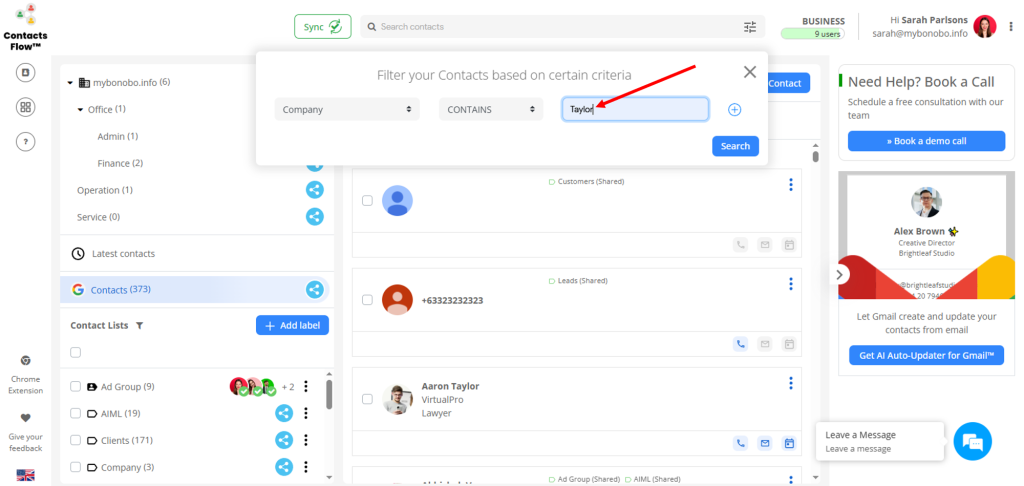
6. Click Search at the bottom of the advanced search panel.
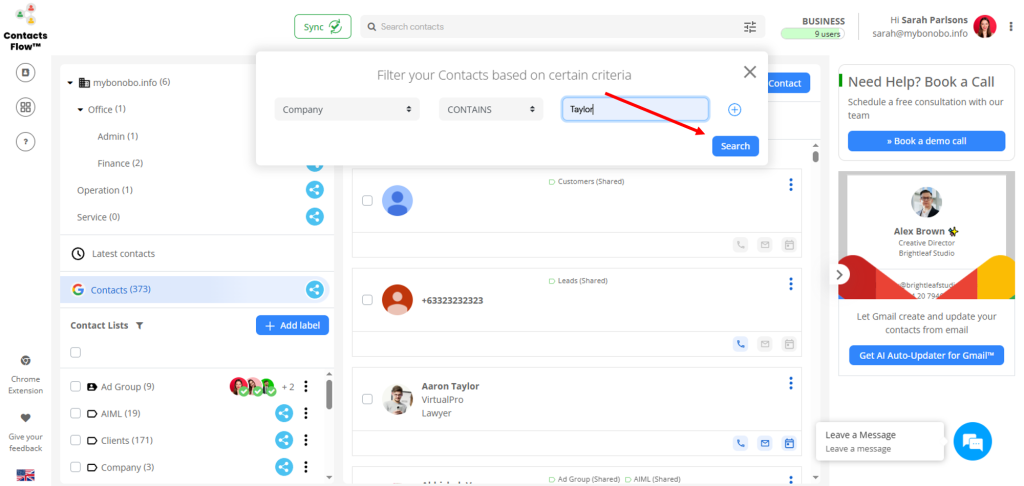
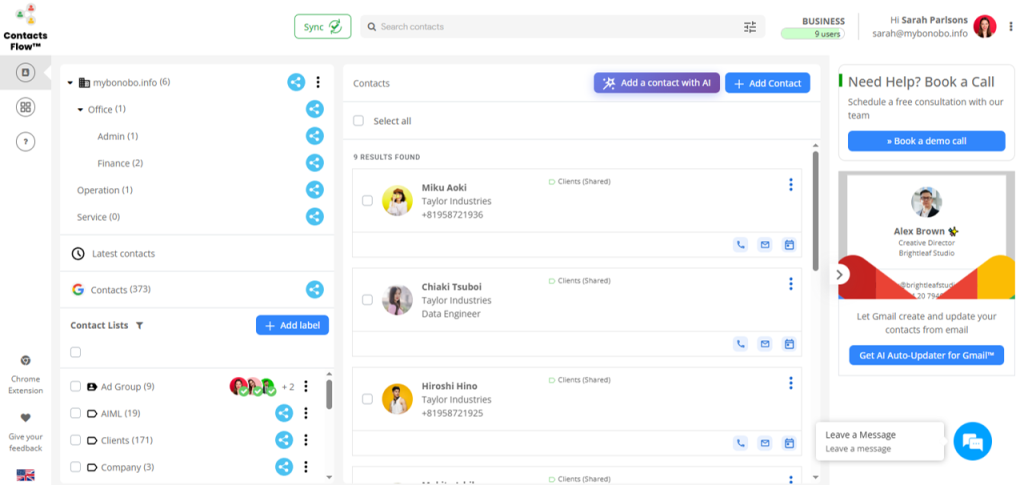
In this example, only contacts whose company name includes “Taylor” will be displayed, while individuals with “Taylor” in their personal name will be excluded.
While searching within a specific field helps you narrow down results, there are also cases where you need to do the opposite—exclude certain entries to clean up or refine your list.
B. See a list of contacts excluding a particular keyword
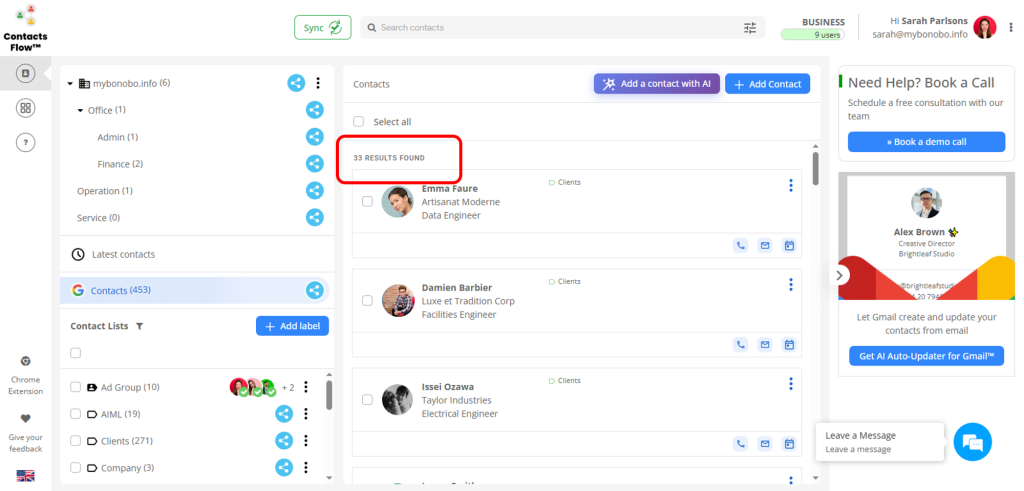
For instance, you need to search for engineers in your contact list, but want to exclude civil engineers. Instead of manually filtering them out from the search results in Google Contacts, you can use the advanced search feature in ContactsFlow™ (formerly Shared Contacts for Gmail™) to set a limitation on your query.
Follow these steps to do so:
1. Go to your ContactsFlow™ (formerly Shared Contacts for Gmail™) dashboard.
2. Click the advanced search icon (
3. Input the required field, operator, and value.
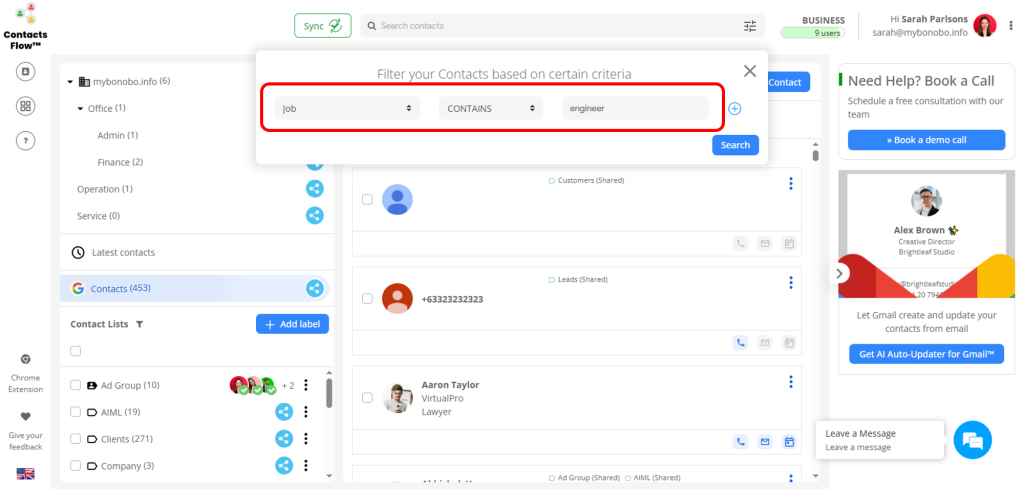
4. Click the plus sign to set the exclusion parameters.
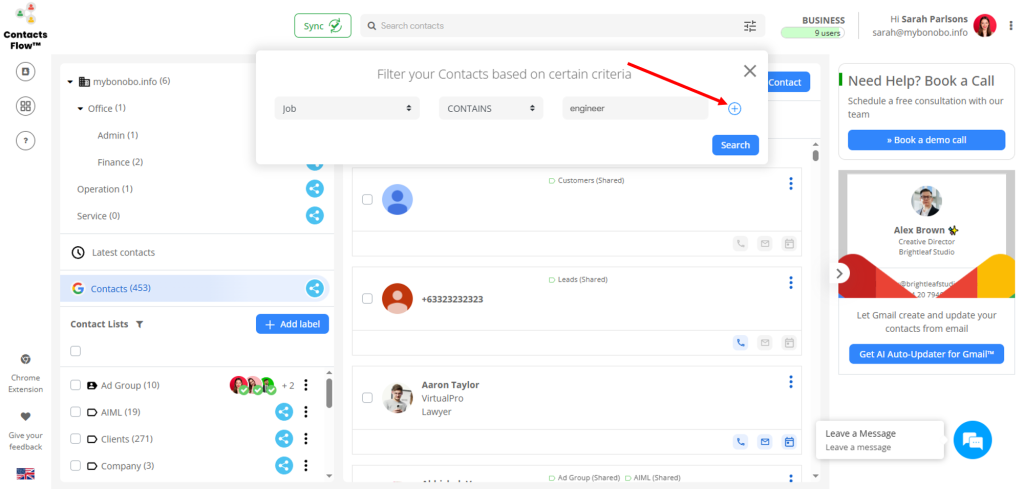
5. Set the limiting parameters.
You can set the limiting parameters in the same field. You may also do it in other fields.
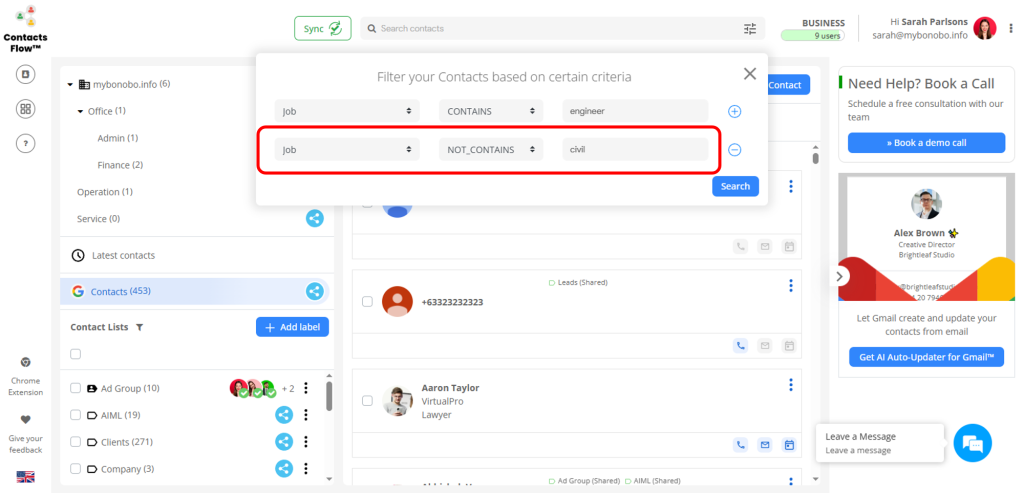
6. Click Search at the bottom of the advanced search panel.
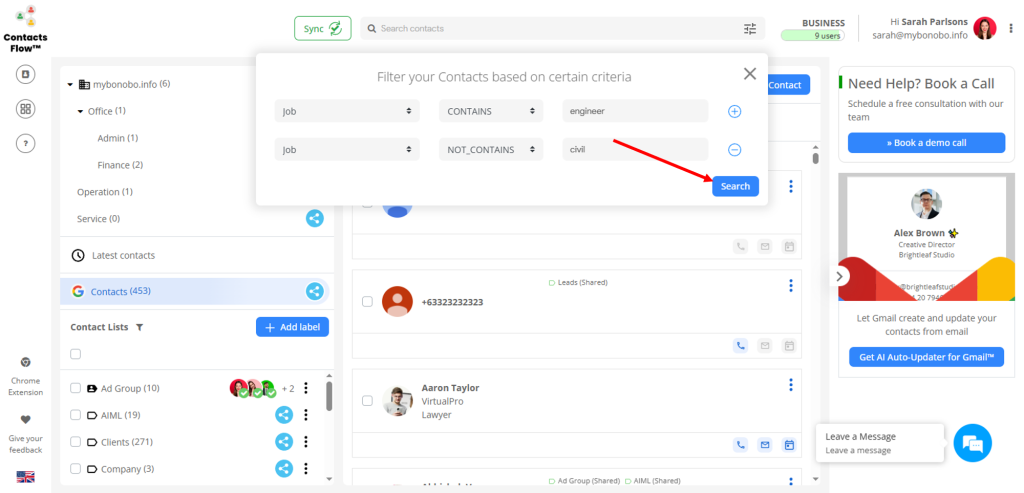
In this case, the search results will include all engineers—data, electrical, business development, QA, and others—except civil engineers. The total number of contacts matching the defined criteria is also displayed, giving you a clear view of how many results fit your query.
While excluding a specific keyword helps you filter out unwanted results, sometimes the focus shifts to improving your data quality. Instead of removing entries, you can identify contacts with missing details so you can review and complete their information.
C. Search contacts with no email, phone number, or other fields
If you want to clean up your contact list by finding entries without an email address, phone number, or other fields, you can use the ContactsFlow™ advanced contact search. You can also group these contacts into a label for easy follow-up. Follow the steps below:
1. Go to your ContactsFlow™ (formerly Shared Contacts for Gmail™) dashboard.
2. Click the advanced search icon (
3. Select the field where you want to find the empty values.
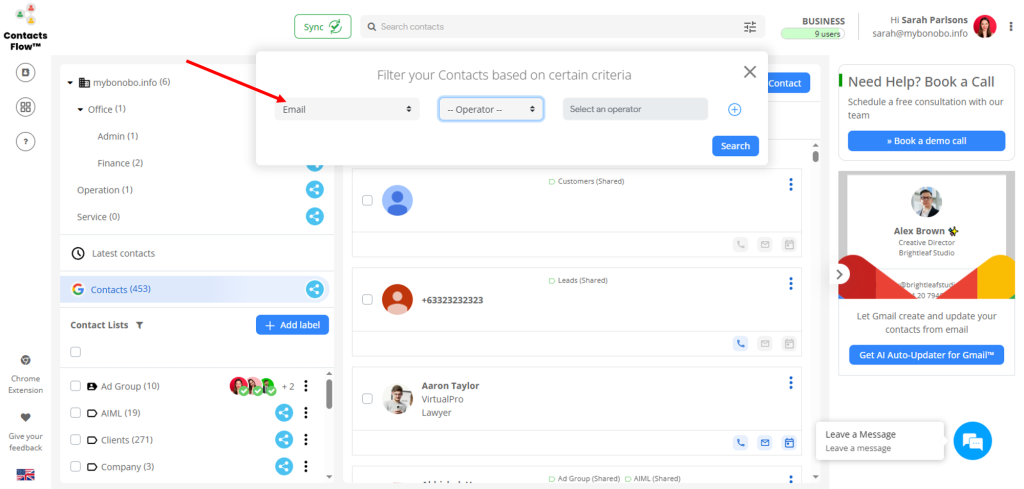
4. Set the operator to ‘is_empty’.
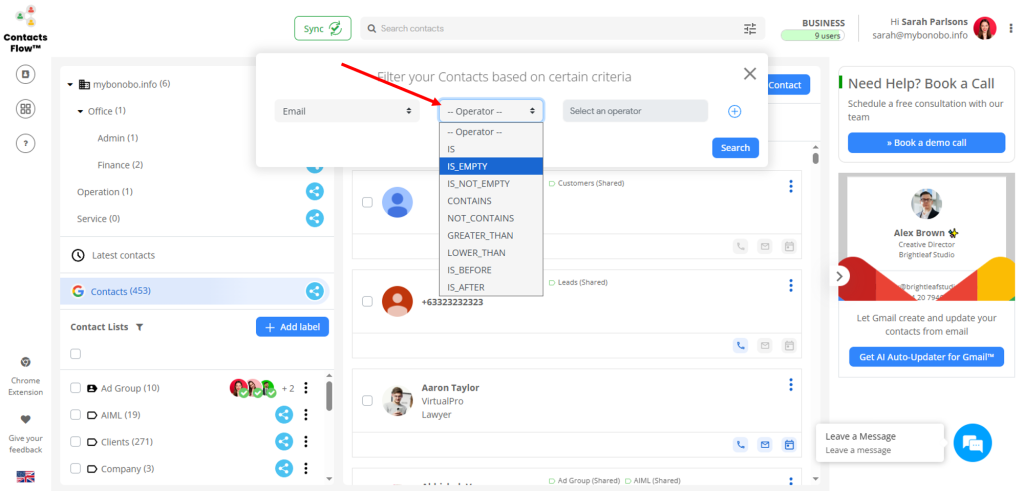
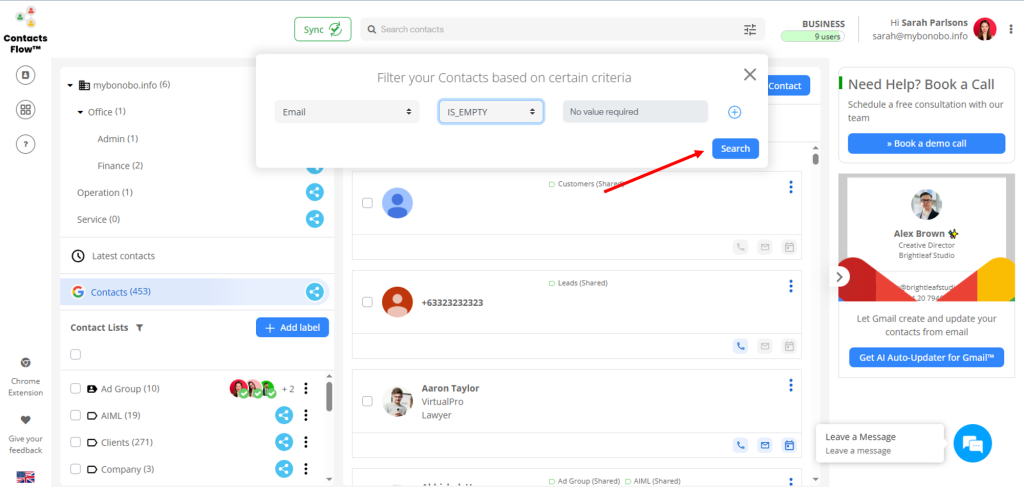
5. Click Search at the bottom of the advanced search panel.
Note that the Value field cannot be set in this case. It is disabled because it is not required when searching for empty values.
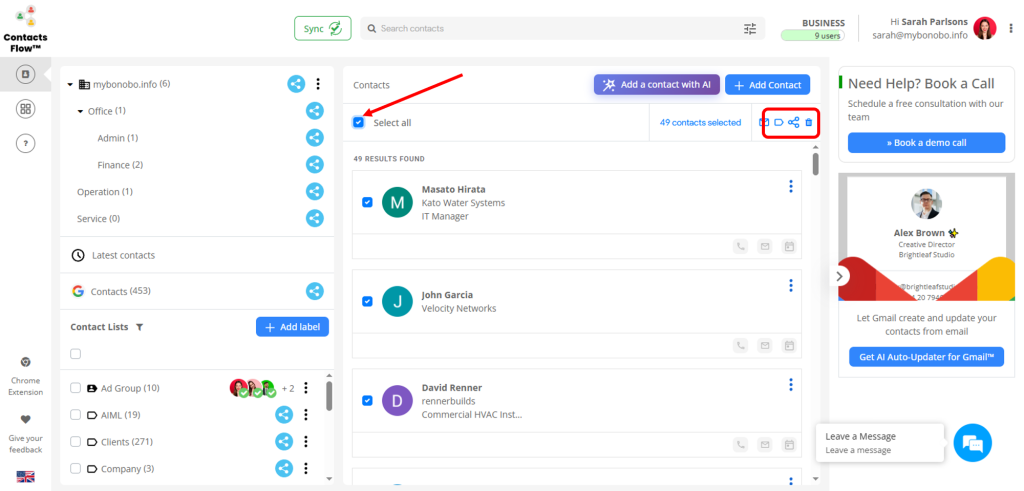
The search displays all contacts without an email address. Tick the Select all box to either put all those contacts into a label, share them with a teammate, or delete them altogether if no longer needed.
After identifying contacts with missing information and improving their details, you may also want to organize your list based on when those contacts were created or updated. This allows you to focus not only on data completeness but also on timing—helping you prioritize recent contacts or revisit older ones that may need attention.
D. Filter Contacts by Date (Before or After)
The ContactsFlow™ advanced search feature lets you filter contacts by date, such as when they were created or last updated.
You can search before or after a specific date to segment your contacts, helping you review, prioritize, and manage your data more effectively over time.
To do so, follow these steps:
1. Go to your ContactsFlow™ (formerly Shared Contacts for Gmail™) dashboard.
2. Click the advanced search icon () at the top right area of the screen.
3. Select the date field you want to use.
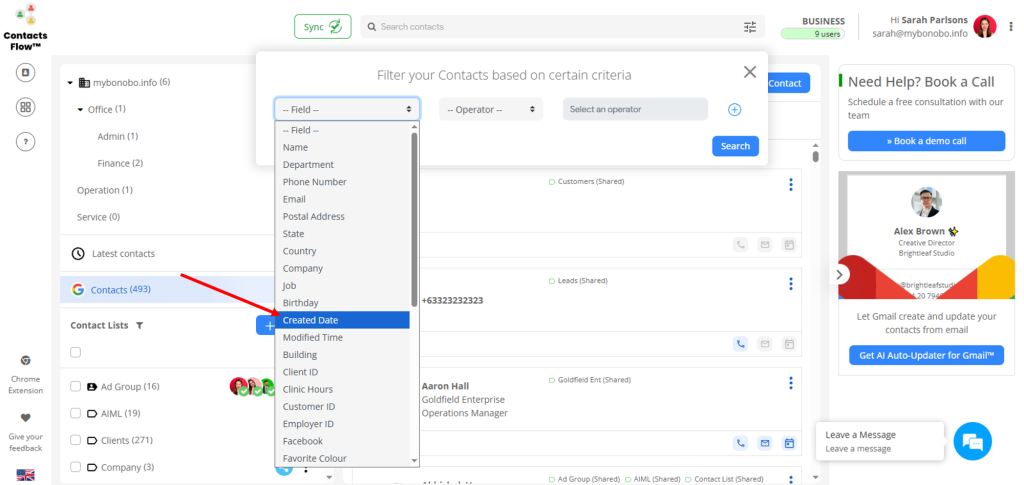
4. Choose whether to filter contacts before or after the selected date.
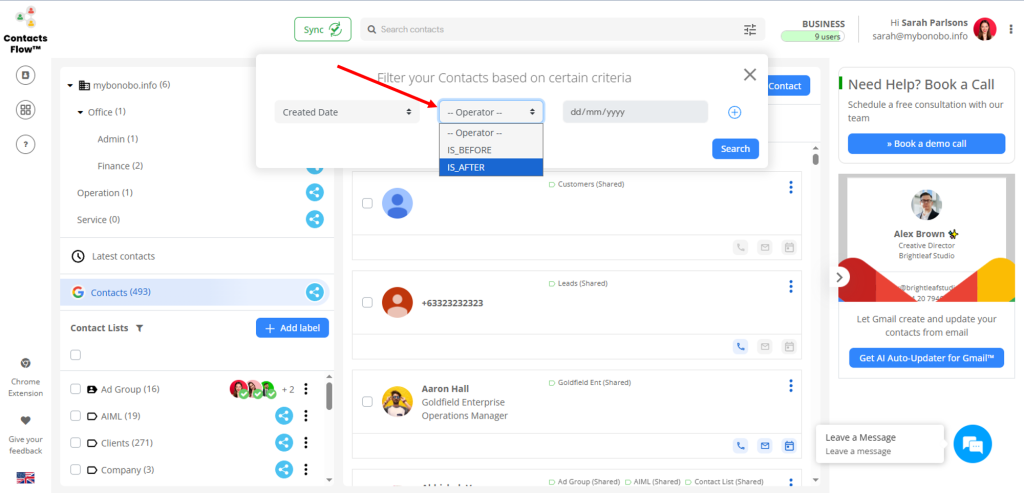
5. Select the date.
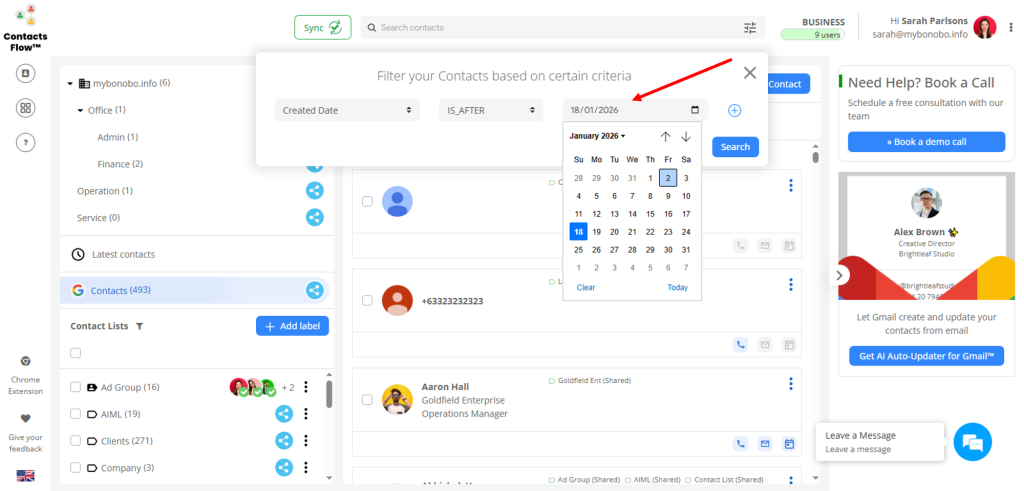
6. Click Search at the bottom of the advanced search panel.
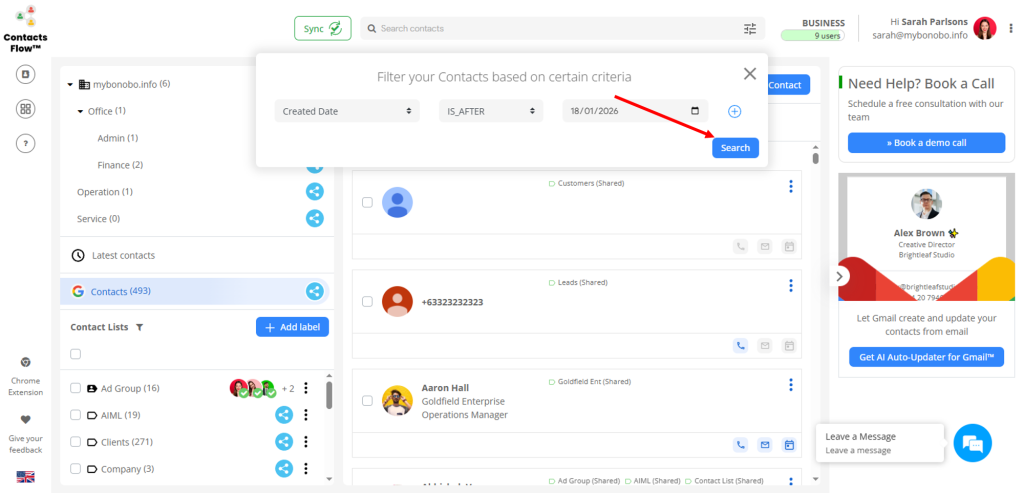
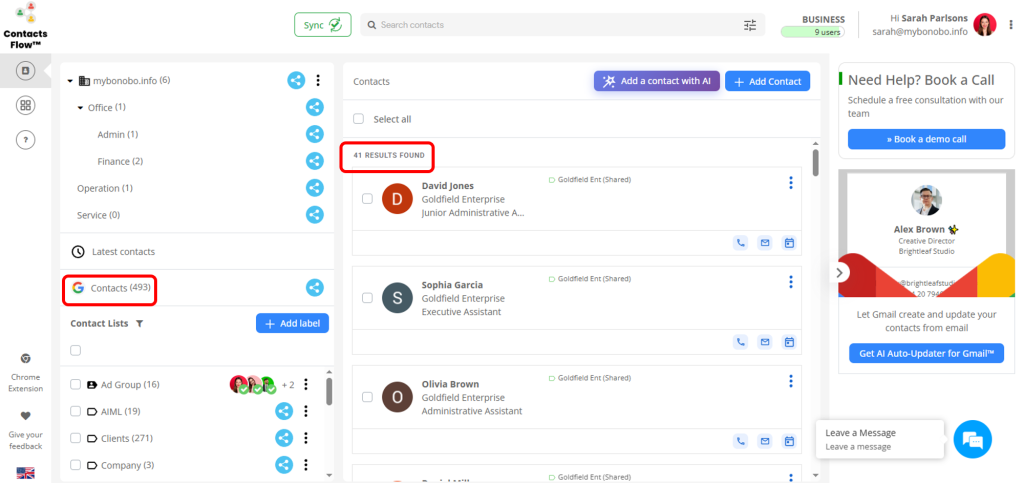
As a result of this example, the advanced search shows that 41 contacts were created after 18/01/2026, out of 493 total contacts.
After organizing your contacts by date, you can take your segmentation a step further by using numeric values. Instead of filtering based on when a contact was created or updated, you can filter based on measurable data such as IDs, scores, or other numerical fields. This allows you to group contacts more precisely based on quantity or range.
E. Filter Contacts from a value less than or greater than a certain number
ContactsFlow™ lets you create custom fields, such as a Client ID, to organize your contacts using numeric values.
For example, you can assign each contact a unique ID and divide them into groups—IDs 2000–2020 for one sales representative, and 2021–2040 for another to support upselling.
With the advanced search feature, you can easily segment these groups:
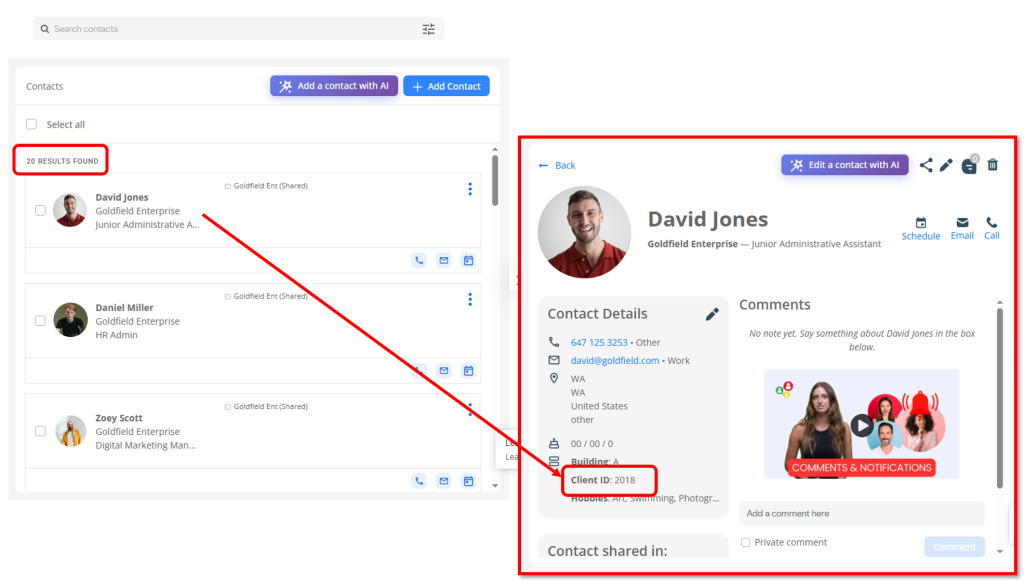
- Set the condition to less than 2020 to display clients with IDs below 2020.
- Change it to greater than 2040 to show clients from 2040 onward.
Follow the steps below to set this up:
1. Go to your ContactsFlow™ (formerly Shared Contacts for Gmail™) dashboard.
2. Click the advanced search icon () at the top right area of the screen.
3. Select the field that contains the numeric value (e.g., Client ID).
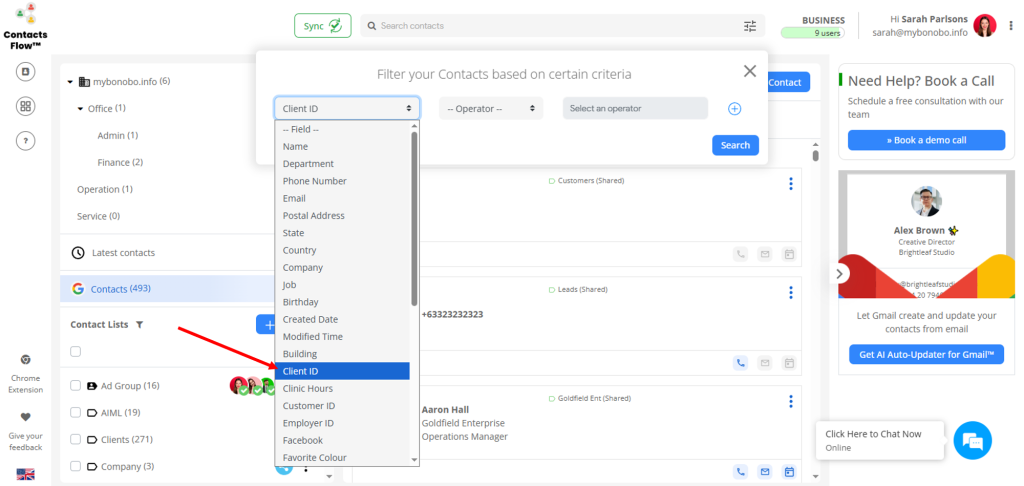
4. Choose the appropriate operator (greater than or less than).
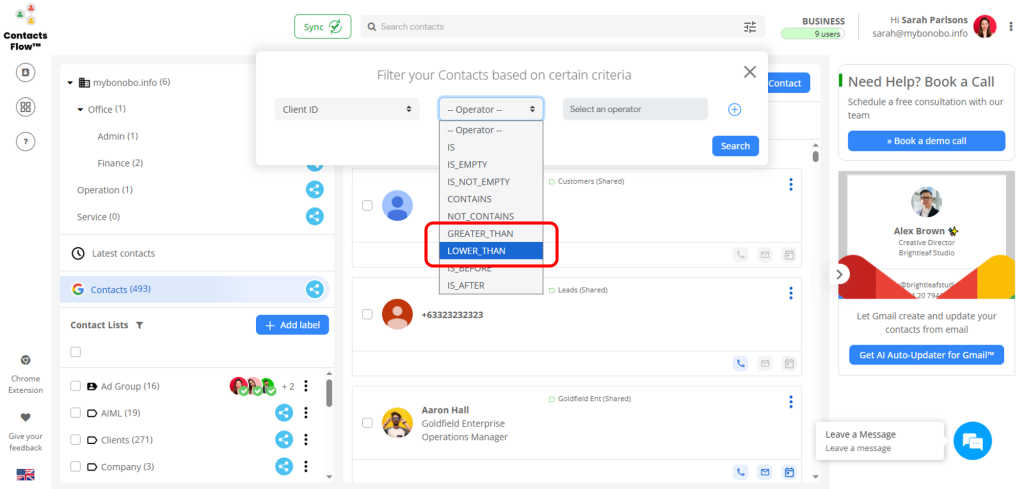
5. Enter the number.
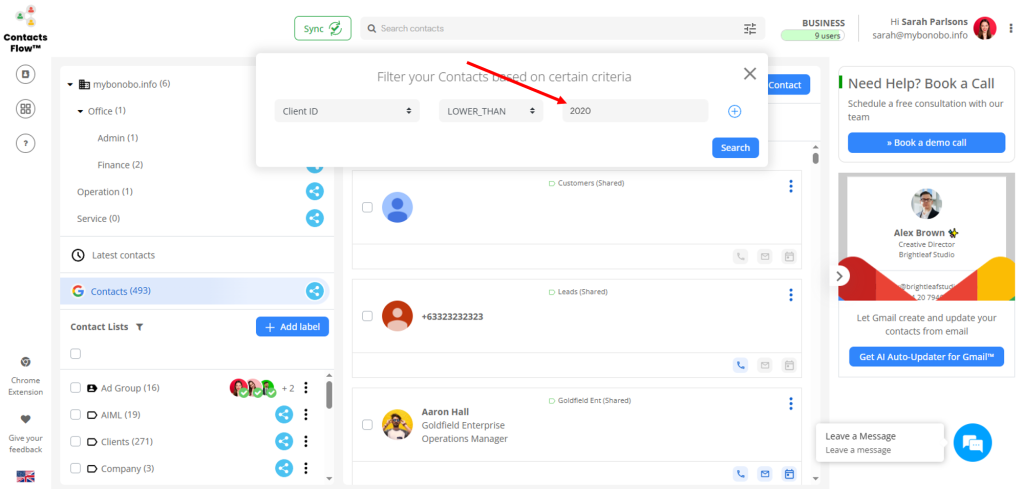
6. Click Search at the bottom of the advanced search panel.
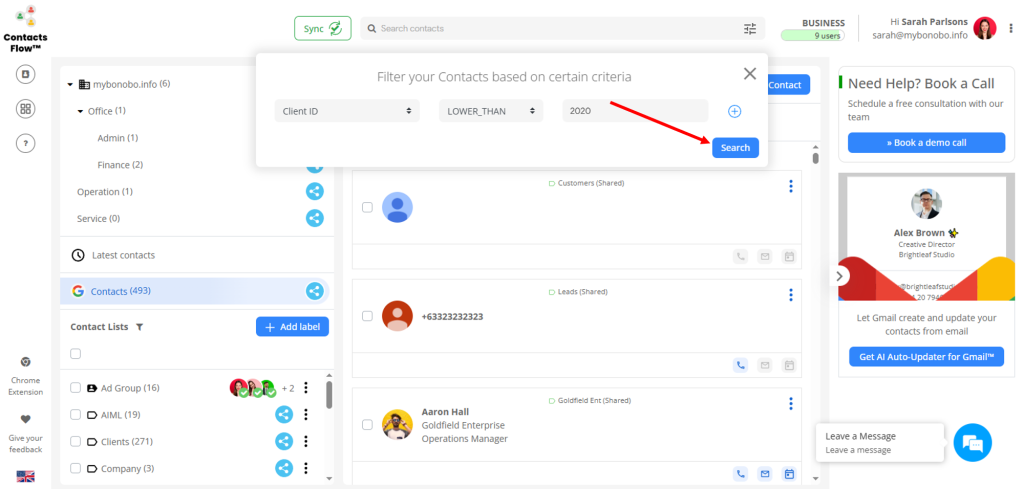
As a result, the matching contacts are displayed, along with the total number in that category.
By using advanced contact search, you can quickly find the exact contacts you need, clean up incomplete entries, and organize your database in a way that supports your daily work. Instead of manually sorting through contacts, you can apply targeted filters based on keywords, missing fields, dates, or numeric values to get precise results in seconds.
Start by identifying one use case that matters most to you—whether it’s cleaning up missing data, segmenting clients, or prioritizing recent contacts—then apply the steps in this guide to build your first filtered list. Once set up, reuse and refine your searches regularly to keep your contact database accurate, organized, and ready to support your team.


